

Quora is a global question-and-answer platform where people ask others for answers on anything and everything. Currently, there are around 430+ million monthly active users on Quora. Adam D’Angelo (current CEO) and Charlie Cheever started the journey back in 2009. Both of them used to work at Facebook before this.
Quora isn’t built for the scroll-and-forget crowd. People show up here looking for something specific — a real answer, someone else’s actual experience, not just a quick reaction.
Heading into 2026, the platform hasn’t lost its edge. It’s still a go-to space for sharing knowledge, building a personal brand, and getting content in front of the right people. Professionals, students, researchers, founders, marketers — they’re on Quora for more than just answers. They’re shaping opinions, sending traffic back to their own sites, and quietly building a reputation as the person who knows their niche.
Let’s know the important Quora statistics for 2026, including who uses the platform and how users engage with content. The article will also walk you through key features that shape participation and how Quora generates revenue.
Consider buying Quora followers to get it started.
💥Quora Statistics: Key Numbers
- 75–82% of traffic comes from organic search (mainly Google)
- 700+ word structured answers perform better in rankings
- 65%+ hold a college degree
- The US accounts for around 36–39% of total visits
- 76% of traffic comes from mobile
- 150,000+ active business accounts
💥Quora Statistics: Overview
Below are the most current statistics about Quora in 2025–2026:
📌Who Uses Quora and Why: User Base & Engagement Patterns
Quora remains a significant global knowledge-sharing platform with a large and engaged audience.
- 430+ million monthly active users (MAUs) worldwide as of 2026, up from 300 M in 2023
- India (140 M MAUs) and the United States (148 M users) are among the largest individual markets
- Users spend about 9 minutes per session on average
- A highly educated demographic dominates Quora: roughly 65% hold a college degree, with 28% holding graduate degrees
- High-income users are overrepresented here: 28% earn >$100,000 annually, and 54% come from households earning >$100,000
📌How Many Questions Are On Quora?
People ask around 3,500 to 5,000 questions every day. By 2026, people have asked more than 2 billion questions. Also, about the answers, approximately 5 answers are three for each question.
📌How Many Topics Are in Quora?
Quora has over 300,000 active topics. Some estimates push that number past a million.
Which topics get the most love? Technology leads the pack with 30 million+ followers. Music, Movies, Science, Business, and Health aren’t far behind. Some topics have crossed 100 million followers.
How specific do topics get? You’ll find everything from massive categories like “Technology” to super-specific niches.
What can you do with topics? Follow the ones you care about. Your feed adapts to show you related content. Questions get sorted by topic, making them easier to find.
📌Key Features of Quora
Quora’s ecosystem offers multiple features that drive both engagement and growth:
- Questions & Answers: On Quora, users ask specific questions, and others provide detailed, often long-form answers. High-quality answers are frequently indexed by search engines.
- Upvotes, Comments & Views: Community voting and interaction help surface the most useful content. This way, popular answers stay visible longer and attract more traffic.
- Spaces: Quora Spaces are topic-based communities. Here, users curate content, share ideas, and cultivate niche discussions, functioning similarly to groups or forums.
- Ads & Promoted Content: Quora Ads allow brands to target users based on interests and questions, making them effective for high-intent audiences. Marketers often find lower competition and targeted reach compared to larger networks.
- Paid Services (Quora+): A subscription available for around $6.99/month or $47.88/year gives users access to exclusive content. Creators and Space owners can earn revenue through Quora+ revenue sharing.
- Poe AI: Quora introduced Poe AI in 2023, an interactive, functional, centralized, third-party interface that allows users to chat with various AI models.
You can buy Quora Shares from Boost Like as well.
➡️Quora App Downloads
iOS + Play Store downloads
| Metric | Estimated Data |
|---|---|
| Total Lifetime Downloads | 88 Million |
| Current Monthly Rate | 100,000 – 120,000 |
| Total Global Ratings | 1.4M+ |
| Rating-to-Download Ratio | 1:60 |
➡️3 Major Ways Quora Generates Revenue
Quora’s business model focuses on a mix of advertising, subscriptions, and partnerships:
- Advertising: Advertising continues to be the largest revenue stream, with roughly $95M annually in ad revenue as of 2026. Businesses use Quora Ads to reach intent-driven users who are actively looking for answers.
- Quora+ Subscriptions: Paid memberships allow users ad-free browsing and access to premium content. Creators and Spaces can earn shares from these subscription fees, creating a recurring revenue model.
- Partnerships and AI Services: Quora’s AI integrations (such as with Poe) and content partnerships contribute to revenue and platform value. In 2026, Poe accounted for a growing share of engagement and revenue via subscriptions and usage.
In 2026, Quora’s total projected annual revenue reached approximately $190 M, up from $120 M in 2024.
If you need a structured Quora profile, you should buy Quora Answers as well.
➡️Quora Usage Statistics (Global & Regional)
Quora’s usage statistics indicate a large, globally diverse user base, solid engagement patterns, and a mobile-first audience.
💥Total Monthly Active Users (MAUs): Global Stats & Growth
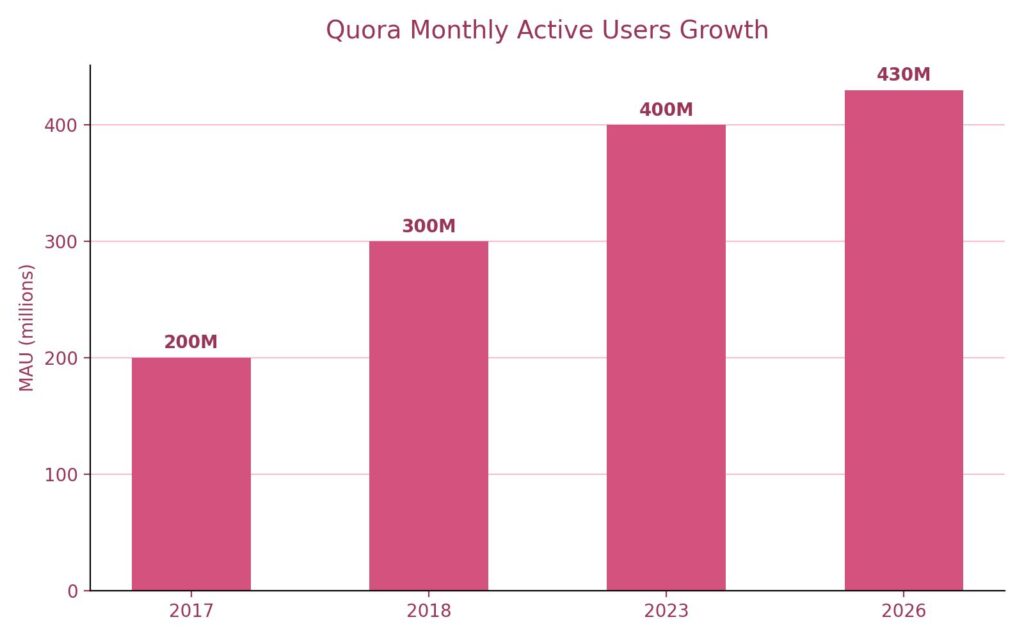
As of 2025–2026, Quora has surpassed 400 million monthly active users (MAUs) worldwide.
In 2018, the platform had about 300 million MAUs, showing a roughly 33% increase over that period.
| Year | Monthly Active Users |
|---|---|
| 2017 | 200 million |
| 2018 | 300 million |
| 2023 | 400 million |
| 2025 | 400 million+ |
[Source: Quora & DemandSage]
📢Daily Active Users (DAUs) & Engagement
Roughly 27 million people show up on Quora every day. That’s the average, anyway — exact DAU numbers shift depending on who’s counting. What stands out more is the time people spend there: sessions often run 4 to 11 minutes, which is a lot for a Q&A site. This isn’t the kind of traffic that clicks in and bounces. People stay, read, scroll through answers, sometimes write their own.
📢User Growth Trends Over the Years (2020–2026)
No explosive spikes here. Quora’s growth has been slow, steady, almost boring in a good way:
- 2017: 200 M MAU
- 2018: 300 M MAU
- 2023: 400 M MAU
- 2025–2026: 400 M+ MAU
[Source: Quora reports & industry data]
➡️Quora Traffic by Country: Top Regions & Share
Quora’s user base and site traffic are geographically diverse but with notable regional concentrations:
💥Quora Users by Country (est.)
| Country/Region | Users (Approx.) | % of Total |
|---|---|---|
| United States | 148 million | 37% |
| India | 100 million | 25% |
| Europe | 70.5 million | 18% |
| Southeast Asia | 24 million | 6% |
| United Kingdom | 22.5 million | 5.6% |
| Middle East & North Africa | 20 million | 5% |
| Canada | 15 million | 3.7% |
| ANZ | 11 million | 2.7% |
| Japan | 6.8 million | 1.7% |
| Mexico | 3.5 million | 0.9% |
| Brazil | 2.6 million | 0.7% |
The United States accounts for roughly 36–39% of visits, followed by India at around 25%, with the United Kingdom, Canada, and Indonesia each contributing a few percent of total global visits.
📢Mobile vs Desktop Usage: Device Breakdown & Marketer Implications
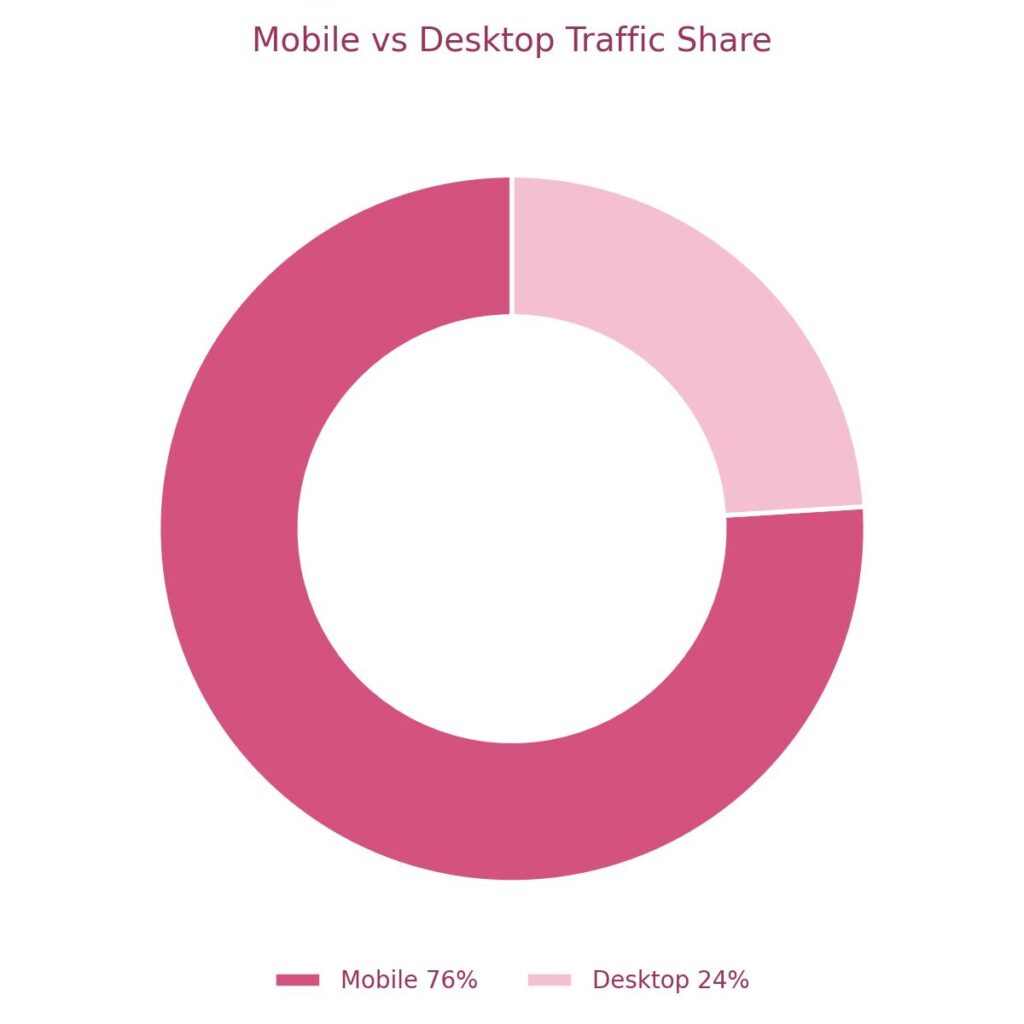
Mobile dominates Quora usage globally:
- 76% of visits come from mobile devices (phones and tablets)
- 24% come from desktops
Marketing implications
- Mobile optimization is essential. Answers and content should be easy to read and scroll on smartphones.
- Ad creatives and CTAs should be mobile-friendly, with clear, concise text and fast-loading links.
- Mobile-first content (short paragraphs, bullets, and clear visuals) performs better than dense text blocks.
🖌Quora User Demographics (2026)
Understanding who uses Quora is key for marketers, researchers, and content strategists.
🖌Age Distribution of Users
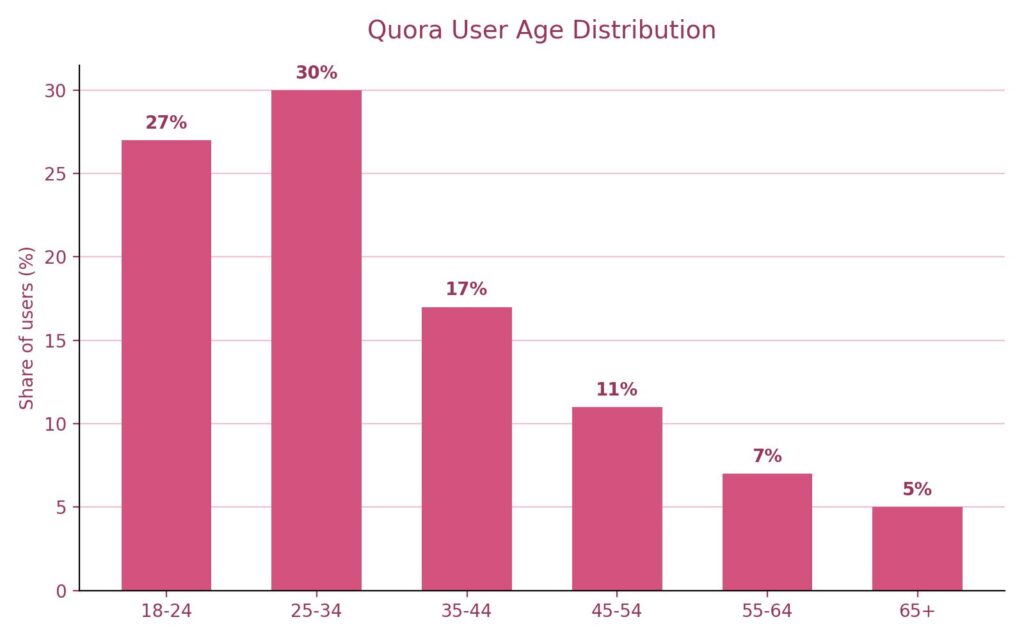
Quora’s audience skews toward younger and mid-career adults, making it valuable for B2B and mid-funnel engagement:
| Age Group | % of Quora Users (approx.) |
|---|---|
| 18–24 | 26–29% |
| 25–34 | 30% (largest cohort) |
| 35–44 | 17–18% |
| 45–54 | 10–12% |
| 55–64 | 7–8% |
| 65+ | 5–6% |
This distribution shows that millennials and older Gen Z form the core of the platform’s audience, benefiting brands targeting young professionals and students alike.
🖌Gender Distribution
Quora has a male-leaning audience, though the gap is narrowing:
- Male: 56–61%
- Female: 39–44%
🖌Education Levels
Quora users are highly educated compared with the general internet population:
- Over 65% have a college (bachelor’s) degree
- Around 28% hold graduate degrees
This makes Quora attractive for thought leadership, expert positioning, and educational content, as many users expect detailed, well-researched answers.
Income Levels
Quora draws a relatively affluent audience:
- Around 28% of users aged 18+ earn $100,000+ annually
- Around 54% come from households with incomes over $100,000
This income skew means Quora is a strong platform for marketers selling premium products, services, or B2B solutions.
Professional Backgrounds
While detailed profession breakdowns are not always fully reported, available data shows a substantial share of the audience comes from professional and leadership roles, and around 37% of users occupy management positions or higher.
Regional & Country-Specific Stats
Quora’s user base is internationally distributed, though concentrated in specific regions:
| Region | Approx. Users | Share |
|---|---|---|
| United States | 148 M | 34–38% |
| India | 100 M | 23–25% |
| Europe | 70–78 M | 17–18% |
| Southeast Asia | 24 M | 6% |
| United Kingdom | 22–23 M | 5–6% |
| Middle East & N. Africa | 20 M | 5% |
| Canada | 15 M | 4% |
| Australia & New Zealand | 11 M | 2.5% |
| Japan | 6.8 M | 1.7% |
| Mexico | 3.5 M | 0.8% |
| Brazil | 2.6 M | 0.6% |
Quora’s largest markets are the U.S. and India, but Western Europe and Southeast Asia also contribute meaningful user bases, beneficial for global reach.
📌How People Actually Use Quora?
Engagement here doesn’t look like engagement on most other platforms — worth understanding if you’re trying to figure out where content actually gets traction.
Time Spent Per Session
People stick around longer than you’d expect. Most reports put average sessions somewhere between 8 and 10 minutes — compare that to TikTok or Instagram, where you’re often looking at under 5 minutes before someone’s gone. Quora’s built around reading, not scrolling, and the numbers reflect that.
📌How Many Questions Get Asked Each Day?
Somewhere between 3,000 and 7,000 new questions go up daily — add that up over a month and you’re looking at roughly 90,000 to 210,000. Most questions end up with around 5 answers on average, though the ones that catch fire can pull in hundreds, sometimes thousands.
📌What Topics Get the Most Attention?
There are hundreds of thousands of active topics on Quora, but engagement isn’t spread evenly — a handful of categories pull in most of the activity:
Top Topics by Followers (Millions)
- Technology: 149.7 M
- Movies: 133.5 M
- Health: 131.8 M
- Science: 121.7 M
- Music: 116.7 M
- Books: 93.8 M
Categories like Education, B2B/SaaS, Jobs, Finance, and Consumer Tech also see millions of questions and active discussions, making them fertile ground for niche marketing content.
➡️Content Interaction – Upvotes, Shares, Comments, and Response Rates
Quora’s structure encourages interaction, but engagement patterns differ from those of typical social platforms:
- Most questions receive an answer, and top answers often garner upvotes that help them stay visible.
- Upvotes and saves are strong signals. Answers with 400+ words and supporting visuals tend to earn more interaction.
- Comment threads build discussion around answers, though detailed comment rate specifics vary by topic and question.
➡️Organic Search Contribution – % of Traffic From Search Engines
Quora’s engagement is heavily tied to discovery via search. 75–81% of Quora’s overall traffic comes from organic search (Google and other search engines).
Many of these organic visitors engage with multiple answers or follow topic feeds, contributing to longer sessions and deeper content interaction.
➡️Social Media Referrals – % of Traffic From Other Platforms
Quora benefits from external referrals, though they represent a small portion of overall traffic:
Social media referrals account for roughly 0.7–0.8% of Quora traffic, with the majority coming from search and direct visits.
Among social sources, YouTube is consistently the top referrer, contributing around 30–34% of the small social traffic share. Reddit often follows closely. Facebook and LinkedIn contribute smaller portions.
Though a small slice of the pie, these social referrals are important amplification channels, especially for creators who repurpose answer content as short videos or threads elsewhere.
🎯Quora Marketing & Advertising Statistics (2026): What Marketers Need to Know
Below are the latest verified insights into how Quora performs as a marketing and advertising platform, including adoption, ROI, formats, performance differences, and marketing trends relevant for both B2B and B2C brands.
Quora Ads Adoption: % of Businesses Using It
Quora’s advertising ecosystem continues to grow among marketers.
About 60% of companies advertising on Quora are B2B, while 40% are B2C, showing broad commercial adoption across sectors.
Over 150,000 businesses have active Quora Business accounts using targeted ad campaigns and analytics tools. Meanwhile, around 27% of marketers plan to increase investment in Quora Ads.
Conversion Rate & ROI Insights
Quora’s native targeting and intent-driven format often result in strong ROI for advertisers. Quora Ads are reported to deliver up to 4× higher conversions compared with other platforms in niche and high-intent categories.
SaaS advertisers using Quora have seen significant increases in signups and lower CPA, such as 83% CPA reduction and 152% signup increase in case studies.
Conversion API (CAPI) and auto-bidding tools enhance measurement and bidding efficiency, helping marketers optimize budgets with machine learning support.
🎯Mobile vs Desktop Ad Performance
Quora’s mobile-heavy audience shows up clearly in the ad numbers too. Somewhere between 70% and 78% of ad interactions happen on mobile — which tracks, given how the rest of the platform’s traffic looks.
Mobile ads tend to outperform desktop here: higher click-through rates, lower cost-per-click. Part of that comes down to the mobile-first interface itself — things like AMP-optimized pages and in-app placements load faster and keep people engaged longer than the desktop experience does.
For marketers, the takeaway is pretty straightforward: if your creatives, landing pages, and CTAs aren’t built with mobile in mind, you’re leaving conversions on the table. High-intent traffic is mostly showing up on phones — the campaign needs to meet it there.
Popular Ad Types & Formats
Quora supports multiple ad formats designed to fit different stages of the marketing funnel.
- Promoted Answers: Blend seamlessly into Q&A threads, establishing expertise and authority while driving traffic and conversions.
- Text Ads: Native text-only ads that integrate within topic and question feeds, effective for messaging tests and direct response.
- Image Ads: Visually compelling ads placed alongside relevant content to increase brand awareness and click engagement.
- Video Ads: Support storytelling, product demos, and social proof with higher recall and engagement.
- Lead Gen Forms & App Installs: Built-in tools for capturing qualified leads and driving downloads without leaving the platform.
This variety allows brands to tailor campaigns to awareness, consideration, and conversion objectives.
🎯Most Followed Brands & Influencers on Quora
While comprehensive verified lists are not centrally published, certain enterprise and tech brands frequently appear as high-profile participants due to promoted content, thought leadership, and topic authority — including major players like Amazon, Apple, Samsung, and others are adopting Quora Ads to reach research-oriented audiences.
These brands often pair organic expertise (high-quality answers) with paid amplification for maximum impact.
Emerging Trends in Quora Marketing
Current trends reflect dynamic changes in how brands approach the platform:
- Video Ads & Rich Formats: Rising adoption of video creative to tell stories and demonstrate products.
- Quora Spaces Integration: Community-centric content hubs that blend organic and paid visibility for deeper engagement.
- AI-Assisted Content Optimization: Tools and integrations that use AI to refine targeting, bidding, and messaging for campaigns.
Marketers increasingly treat Quora as a complement to SEO, thought leadership, and intent capture strategies, not just an ad channel.
🖌Paid vs Organic Content Impact
Organic content (high-quality answers) builds long-term authority and SEO value. Many answers rank on Google and continue driving traffic months later.
Paid campaigns accelerate visibility and conversion, especially when timely and aligned with organic expertise. Case studies show that combining promoted answers with organic contributions often amplifies overall engagement and traffic.
ROI perspectives indicate that Quora Ads can deliver lower CPLs and competitive CPCs compared to LinkedIn and other platforms.
ROI Case Studies & Examples
- Webflow: Reduced cost per acquisition by 83% and increased signups by 152% using a mix of Promoted Answers and interest targeting.
- Sprite (Coca-Cola): Achieved ~32 million impressions and ~10% CTR in a campus campaign targeting students.
- Shopify & Udemy: Reported 4× CTR and up to 5× ROAS in tailored campaigns leveraging Quora’s intent data.
🎯Quora Revenue, Valuation & Business Insights (2026)
Quora Revenue by Year: Historical and 2026 Estimates
Quora’s revenue has grown steadily as it diversifies beyond advertising. In 2023, the platform generated about $20 million in annual revenue from ads, Quora+ subscriptions, and monetization programs.
By 2026, Quora’s total projected annual revenue is estimated at around $190 million, with major contributions from:
- Advertising (around $95 M)
- AI subscription services (example: Poe) (around $65 M)
- Quora+ consumer subscriptions (around $20 M)
- Creator payouts and partner programs (around $10 M+)
This diversification has reduced reliance on ads to less than 55% of total revenue, giving Quora more stable long-term growth potential.
💥Valuation Insights: Funding & Market Value
Quora has raised capital across multiple rounds, with a notable $75 million funding raise in January 2024 led by Andreessen Horowitz to support AI expansion.
Recent market analysis places Quora’s valuation at approximately $2 billion – $2.5 billion in 2026, significantly higher than earlier estimates from the 2010s. This valuation reflects investor confidence in Quora’s hybrid model (knowledge + AI), global growth, and monetization strategy.
💥Business Strategy Overview: Monetization & Competitive Positioning
Quora’s strategy focuses on:
- Advertising: Quora Ads allow targeted, intent-driven campaigns and are a key revenue pillar.
- Subscriptions: Paid services like Quora+ and AI offerings (e.g., Poe) boost recurring revenue.
- Creator monetization: Revenue sharing encourages expert contributions, which in turn enhances content quality and engagement.
- International expansion: Localized content and multilingual support broaden global reach.
💥Quora vs Other Knowledge Platforms
| Platform | Monetization Focus | Traffic Trends | Core Strength |
|---|---|---|---|
| Quora | Ads + subscriptions + creator programs | Steady growth, strong SEO | Intent-driven Q&A content |
| Ads, premium membership | Topical forums, community engagement | Community discussions | |
| Medium | Subscriptions + partner earnings | Niche publishing | Long-form narrative depth |
| Ads + premium tiers | Professional network | Career & B2B insights | |
| Stack Overflow | Enterprise + job ads | Dev audience | Technical Q&A specialization |
Compared to Reddit and Stack Overflow, Quora’s strength lies in search engine visibility and long-tail traffic, while LinkedIn and Medium are stronger in professional and storytelling contexts, respectively.
💥Quora vs Reddit Traffic Comparison
| Metric | Quora | |
|---|---|---|
| Monthly Visits (Jan 2026) | 430 million | 5.14 billion |
| Month-over-Month Change | -6.41% (from Dec 2025) | -1.32% (from Dec 2025) |
| Average Session Duration | 08:37 minutes | 12:43 minutes |
| Primary Traffic Sources | Direct: 43.55% Google: 40.23% | Google organic: 63% Direct: 29% |
| Global Rank (approx.) | ~85 | 6 |
| US Rank | 49 | 4 |
| Bounce Rate / Pages per Visit | 68% in some competitor views | 59% in views |
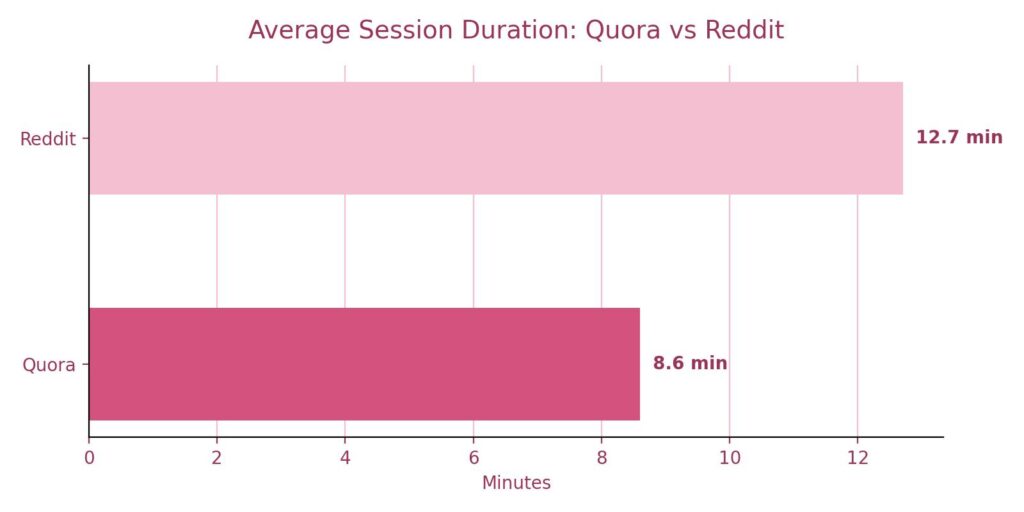
⚠️Quora Traffic & SEO Insights
Let’s have a look at Quora traffic and SEO insights.
Organic vs Paid Traffic Split
Quora’s traffic is highly organic. Around 80-82% of visits come from search engines, with direct visits making up much of the rest. Paid search and display ads contribute negligible direct traffic compared to SEO.
⚠️Top Keywords Driving Traffic
Quora ranks for millions of keywords on Google’s first page, especially for informational, problem-solving queries. Many of these are non-branded keywords (e.g., “best skincare routine,” “how to learn Python”), which represent approximately 75–80% of organic traffic.
Branded keywords (mentioning specific companies or products) make up a smaller share but still contribute to niche visibility, especially for marketer-generated Q&A content.
Referral Traffic Insights
While organic search dominates, social referrals still play a role:
- YouTube is a leading social referrer (~29–30% of social traffic directed to Quora)
- Reddit is a close second (~28–29%)
- Facebook, LinkedIn, and other platforms contribute smaller shares
These referral patterns show that Q&A content can be amplified through related communities and video platforms.
⚠️SEO Opportunities for Marketers
Quora isn’t just a Q&A site — it’s also become a legit SEO play for businesses and content creators. A few reasons why:
- Answers on Quora regularly rank for long-tail, informational searches, which means traffic keeps trickling in long after you’ve posted
- Links back to your site from a well-placed Quora answer can lend some domain authority, helping your own pages climb rankings too
- Well-written, keyword-aware answers do double duty — they build brand visibility and show up in organic search at the same time
- Some marketers are now pairing AI tools with their SEO approach, shaping answers around actual search intent to get more discoverability
- There’s also a pattern worth noting: longer, more structured answers — think 700+ words with relevant keywords — tend to rank more often than shorter ones
⚠️Platform Features & User Experience Insights (Quora 2026)
Quora has layered in a handful of features over the years that shape how people actually use the platform.
Quora Spaces & Communities
Spaces are basically topic-based communities — a place to group questions, answers, and posts around one shared interest. Think of them as hubs: they pull niche content into one spot and make it easier for people to find and dig into.
Owners running a Space get access to their own analytics — views, upvotes, comments, activity over time, who’s contributing the most. That data makes it easier to figure out what’s working and where to push for more growth.
What makes Spaces useful for creators is the audience they build. Instead of one-off question-answer exchanges, you get an actual following — people interested in SaaS, AI, parenting, fitness, whatever the niche is — who stick around for ongoing conversation rather than a single interaction.
Mobile App vs Web Experience
Quora’s mobile usage is dominant: nearly 76% of traffic comes from mobile devices, with desktop accounting for about 24% of usage.
The Quora mobile app sees over 100 million installs on Android alone and often delivers a more consistent experience due to push notifications, in-app analytics, and optimized browsing behaviors.
Mobile App Insights
Users open the app about 2.3 times daily on average and are 85% likely to remain active after 90 days, showing strong retention in the mobile environment.
In-app engagement (including ad clicks) is significantly higher than on desktop, and mobile users typically scroll through more questions per session.
From a marketer’s standpoint, mobile-first content and ads are essential due to higher engagement, faster scroll behavior, and stronger CTA interaction on small screens.
Quora+ Paid Subscription Insights
Subscribers get an ad-reduced experience and premium answers from creators who opt into Quora+. This model gives influencers and subject-matter experts a way to earn for their content while retaining engagement from paid audiences.
Platform Usability & Navigation Statistics
Over 300,000 topics exist on Quora. This gives users a rich taxonomy for discovery. Users typically follow multiple topics and questions, creating personalized content feeds.
Quora’s search-centric design means many sessions start with a query rather than browsing feeds, leading to search + related feed navigation patterns rather than endless scrolling.
Detailed Engagement Metrics
Let’s have a look at the engagement metrics for Quora.
Question-to-Answer Ratios
On average, questions posted on Quora receive about 5 answers each, though some highly popular or trending questions attract far more responses.
Daily question volume ranges between 5,000 and 7,000 new questions, totaling roughly 150,000–210,000 monthly questions. This high answer rate means most questions are answered within hours or a day.
About 60% of users come back weekly — that’s not casual browsing, that’s habit. And the time they spend once they’re there backs it up: sessions average 4 to 11 minutes, long enough to actually read through answers and click into related content, not just skim the headline.
Upvotes / Shares / Comments per Post
A popular question can rack up thousands of views and hundreds of upvotes over time, though the numbers swing a lot depending on the topic and how good the answer actually is. One pattern holds up pretty consistently, though: longer answers — 400+ words, with images — tend to pull in more upvotes and shares than short ones.
Comments follow a similar story. Roughly 60% of answers that get any comments at all turn into some kind of back-and-forth, which suggests people aren’t just dropping a reaction and leaving — they’re engaging with the actual substance of what’s written.
📌Top Topics by Engagement
High-engagement topics include:
- Technology
- Movies
- Health
- Science
- Music
These categories have tens to hundreds of millions of followers and consistently high interaction rates.
Interaction patterns show that:
- Niche technical or professional topics (e.g., SaaS, AI, career advice) often produce more answers with higher average upvotes and longer discussions.
- Evergreen “how-to” questions drive consistent engagement and long-term traffic, as users repeatedly stumble upon these answers via search.
Insights for Marketers
This suite of engagement metrics shows that Quora isn’t a fast-scroll social feed. It’s more like a knowledge engine with search and community features.
High-quality content can stay relevant for months or years, and topic engagement signals are strong indications of audience interest. Content marketers benefit from focusing on depth, relevance, and topical authority rather than frequency alone.
⚠️Interesting Quora User Facts & Behavioral Insights (2026)
Some of the interesting facts and behavioral insights regarding Quora are-
Gender & Response Patterns: Males vs Females
Quora’s user base is male-leaning, though the gap has narrowed over time: about 56–61% of users are male, and 39–44% are female as of 2025–2026.
Male users tend to dominate tech, finance, and business discussions, while female users participate strongly in health, education, lifestyle, and work-life balance topics.
This results in distinct interaction patterns. Male-oriented topics often see more technical answers and upvotes, while female-oriented discussions draw nuanced personal and experiential responses.
Management & High-Income User Concentration
Quora skews toward professionals and higher-income individuals. Nearly 28% of users earn over $100,000 annually, and 54% are from households above that threshold.
Around 37% of users report management or leadership roles, indicating a strong presence of decision-makers and mid-career professionals.
Average Questions Answered Per User
Quora doesn’t publicly share a definitive per-user answer metric, but average engagement can be inferred from platform patterns:
On average, each question receives about 5 answers, suggesting frequent participation among active contributors.
Many experienced contributors answer multiple questions daily to build visibility, especially in high-traffic topics.
While a small share of users post most of the answers, returning users often participate repeatedly. It indicates that answering quality questions is a reliable way to build a follower base.
Most Popular Questions & Spaces
Some categories consistently generate high interaction on Quora.
Technology remains one of the most subscribed and active areas, with more than 140 million followers. Other widely followed spaces include Health, Education, Finance, and Jobs/Career.
Examination of trending and high-interaction Spaces shows that topics with practical, decision-oriented questions (e.g., “best programming languages to learn” or “career advice for data scientists”) draw sustained attention and diverse answers.
🎉Trends in Content Creation & Consumption
AI & Content Behavior
AI topics and usage patterns are rising sharply on Quora. In AI-related discussions, a majority of surveyed users report engaging with AI tools like ChatGPT, with over 65% saying they’ve used or referenced AI tools recently.
Remote Work & Education
Niche topics like Remote Work don’t pull the biggest crowds overall, but the interest is real — especially among younger professionals and students trying to figure out how work is changing and what skills actually matter now.
Education-related questions hold up as one of the more reliable engagement drivers too — career paths, skill-building, courses, academic decisions. People keep coming back to that kind of content because it’s the stuff they’re actually trying to figure out for themselves.
Key Takeaways & Insights for Marketers
Quora remains a high-intent, knowledge-driven platform with 300+ million monthly users, making it especially valuable for marketers targeting users who are actively researching answers, products, or solutions.
Essential Numbers & Trends
- 300+ million MAUs globally, with a strong presence in the US and India
- 60%+ traffic from organic search, giving Quora long content lifespans
- Mobile-first usage (70%+), but desktop users show higher conversion intent
- High concentration of educated, professional users, including managers, founders, and decision-makers
Fast-growing topics: AI, SaaS, career growth, education, finance, and remote work.
Key Opportunities for Marketers
- Top-of-funnel dominance: Users arrive with questions, not distractions
- B2B & SaaS-friendly environment: Longer answers = deeper brand authority
- SEO spillover: Quora answers rank on Google and drive off-platform traffic
- Lower ad competition compared to Meta or Google in many niches
Actionable Strategies
- Content: Write long-form, value-first answers targeting high-intent questions; optimize for featured snippets.
- Authority building: Answer consistently in 5–10 core topics tied to your niche; follow relevant Spaces.
- Advertising: Use promoted answers and retargeting for mid-funnel users; test desktop-heavy campaigns for B2B.
- Audience targeting: Target by question topics, interests, and high-income geographies.
- Measurement: Track assisted conversions and organic lift, not just last-click ROI.
- Bottom line: Quora works best when treated as a trust-building and intent-capture channel, not a quick-viral platform.
🎉Final Thoughts
Quora in 2026 is a weird hybrid — half search engine, half community, half AI experiment (yes, that’s too many halves, but that’s kind of the point). Over 400 million people log in monthly. A lot of them are college-educated, decent income, the kind of audience marketers actually want to reach. Most arrive through a Google search, end up reading longer than they planned, and somehow come back the following week.
No dancing, no trends, no fifteen-second hooks. People land here with an actual question and they want a real answer — something they can use. Write something genuinely helpful, and it doesn’t disappear after a day. It can keep pulling traffic for years.
If you are serious about growth, you can always buy Quora Answers from Boost Like.
📌Frequently Asked Questions
📌What is Quora’s global traffic ranking?
Quora typically ranks within the top 100–150 websites worldwide and top 50 in the US, driven largely by organic search traffic.
📌How Quora Makes Money?
Quora runs on ads and subscriptions. The ads match what you’re reading about. Businesses love it because Quora users are educated and actually spend money. Starting a campaign costs as little as $25. Quora+ is the subscription option. Pay $5 to $7 monthly, and you get no ads plus access to premium content. Quora Spaces works similarly. Owners can charge for access to their private communities. Quora takes about 40% of that fee. The company pulls in around $20 million yearly despite 300+ million monthly visitors.
📌Is Quora effective for marketing?
Short answer — yes. It works especially well if you’re doing B2B, building thought leadership, or chasing people who already know what they want (high-intent traffic, basically). You get organic reach without paying for it, plus targeted ads if you want to push further.
📌Is Quora growing or declining?
Growing, and not by a little. Right now it’s pulling in over 400 million people a month. For context: back in 2018 that number sat around 300 million. Five years later, in 2023, it had climbed past 400 million. And some reports floating around in 2026 put it even higher — 430 million.
📌What are Quora’s most popular topics?
Tech and AI lead the pack these days. After that you’ve got Business, Careers, Education, Health, Finance, Self-Improvement — the usual suspects. Remote work has also been climbing fast, riding the same wave as AI interest.
📌How much time do users spend on Quora daily?
Users spend around 10–15 minutes per day on average, with higher engagement for in-depth, informational content.
About The Author
Megan Elis
Megan Elis is a content and digital marketer based in the USA. For over thirteen years, she has worked as a freelancer for several social media marketing companies. She has acquired skill sets in copywriting, content marketing, SEO, and social media marketing. She’s one of the founding members of SEOSkit, an exciting search engine marketing startup. In her free time, she likes to travel, read, and make failed attempts at music.
Products by Category


1 Quora Post – Quora Backlinks
$19.07

10 Quora Custom Comments
$11.6610 Quora Post – Quora Backlinks
$117.65100 Quora Followers
$9.545 Quora Post – Quora Backlinks
$87.97Quora Answer Views
Price range: $1.45 through $4.99Quora Likes
Price range: $4.99 through $51.99Quora Reports
Price range: $3.99 through $23.99Quora Shares
Price range: $7.99 through $57.00Quora Upvotes
Price range: $7.99 through $67.00
Visitors: Traffic from Quora
Price range: $0.99 through $8.99