
If you think GitHub is just a site for storing code, then, as they say, you haven’t been in production.
In the world of developers, GitHub is not just a repository — it’s an entire ecosystem.
And yes, it has a paid subscription.
And no, it’s not just a donation to the developer.
It’s a whole arsenal of tools worth paying for.
Especially if you’re looking for that very GitHub for professionals (we’ve got it — right here).
What GitHub is and what plans it has?
GitHub is something like a social network for developers, only instead of cats, there are pull requests and CI/CD.
The platform allows you to store code, work in teams, automate processes, and not get lost in a million branches.
Both pet projects and large companies live and survive here.
If you’re a developer — you know about GitHub.
Free GitHub features
The free plan is like going camping when everything is there, but the axe is dull, and the internet catches only through a tree.
Maybe a crappy analogy…
Yes, you can create public repositories, make commits, fork other people’s projects, and even automate a bit.
But if you need more — there’s no way without a paid plan.
GitHub paid subscription: main plans
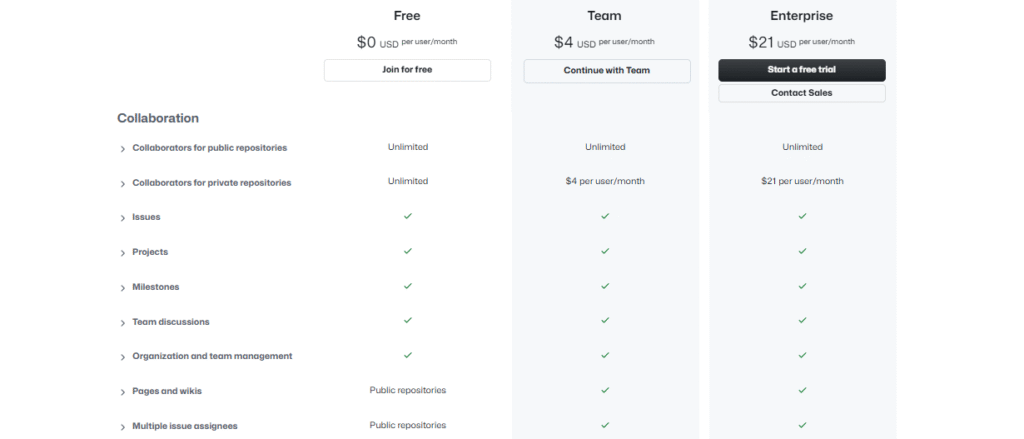
GitHub Team subscription — for mini-teams where everyone knows whose coffee is hotter.
Enterprise — when the team has already turned into a whole department, and every pull request comes with a meeting.
GitHub Pro features — everything from free + individual enhancements the developer gets.
A paid GitHub Pro account is not just a sticker “I support the project.”
It’s access to private repositories, improved analytics tools, CI/CD integrations, and also exclusive features like GitHub Codespaces.
Is it convenient? More than enough.
Check out all available options at Boost Like.
GitHub private repositories
With a Pro account, you can create unlimited private repositories.
Want to build your startup quietly? Go ahead.
Working on a pet project and don’t want people judging your messy commits? No one will ever know.
How to set up GitHub Pro
Sounds fancy, but in fact — just a couple of clicks:
Go to settings, choose the needed plan, pay (they even accept crypto) — and voilà, now you officially have “Pro” in your nickname.
So if a colleague starts arguing — you can instantly flex.
Even easier — buy a ready-made account with all parameters on Boost Like.
Advanced analytics and automation tools
GitHub Pro gives access to extended statistics and GitHub Actions.
You can automate everything: from project builds to wishing your team a good morning.
Just magic, but with YAML.
GitHub subscription for teams: Team and Enterprise
When there are already more people in your team than fingers on one hand — it’s time to move to Team.
And if your project includes people from 4 time zones and their own DevOps — welcome to Enterprise.
GitHub Team vs Enterprise: key differences
Team — everything needed for smooth collaboration in a small group:
– Access control, private repos, Jira integration, tech support.
– Enterprise — for those who live by SLA and breathe DevSecOps.
– Security settings, SAML, 24/7 support, and other “all-inclusive” things.
Access management and security
- A developer shouldn’t see what they don’t need.
- Simple as “Hello, World!” — roles, permissions, folder-based access control.
- Works as precisely as a cron script on schedule.
In plain terms — why businesses should pay for GitHub
- Because “free” always comes with a catch.
- And here, for a reasonable price, you get a platform where you can develop serious products without fearing that tomorrow someone will leak your code to Stack Overflow.
Comparing free and paid GitHub
What’s available for free:
- Public repositories
- Basic automation
- Simple teamwork
And yes, that’s enough to start.
But as soon as you want to scale — you hit the limits.
What features are available only on paid plans
- Private repositories
- Advanced GitHub Actions
- Access control
- Integrations and improved teamwork tools
That’s where the real “GitHub for professionals” begins.
When you should switch to the paid version
If you’re serious about coding, managing projects, working in teams, or just want peace of mind — it’s time to switch.
A comparison of free and paid GitHub shows the benefit is obvious right from the start.
Choose one of the offers from our marketplace and save time while taking your work to the next level.
Advantages of paid GitHub for developers and teams
Security and privacy
– A paid account = your code under lock.
– Neither competitors nor random viewers will see anything.
– Peace of mind at the price of a coffee, or something like that.
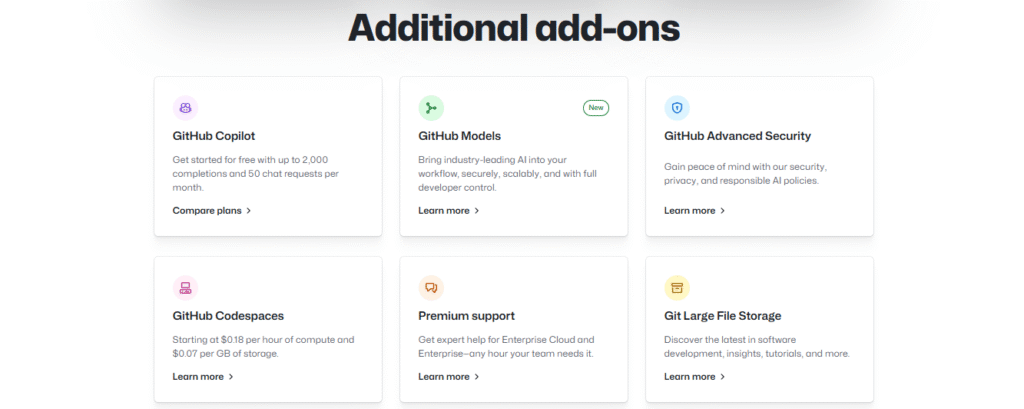
Access to GitHub Actions, Copilot, and other tools
– Copilot — like a junior dev who never gets sick and is always available.
– And Actions help automate everything, even congratulating your team lead on their birthday.
Support and SLA
– You pay — you get.
– Something not working? They’ll help.
– Got questions? They’ll answer.
Speed and workflow automation
– Less manual work, more sense.
– GitHub with a paid subscription brings order to the chaos of commits, tasks, and pull requests.
In short, if you’re not just dabbling but a developer with ambition — a paid GitHub is your path to IT comfort.
💡 GitHub Plans Comparison
| Feature / Plan | Free | Pro | Team | Enterprise |
|---|---|---|---|---|
| Private Repositories | Limited | Unlimited | Unlimited | Unlimited |
| GitHub Actions (CI/CD) | Basic | Advanced | Advanced | Full Automation |
| Analytics & Insights | Basic | Extended | Team-wide | Organization-level |
| Access Management | No | Limited | Role-based | Enterprise-grade |
| Integrations (Jira, CI/CD, etc.) | Basic | Extended | Full | Custom |
| Security & SAML SSO | No | No | Partial | Full |
| Priority Support | Community only | Email support | Business support | 24/7 Dedicated support |
| Best for | Beginners, students | Freelancers & Devs | Small teams | Large organizations |
The question isn’t “why,” but “why haven’t you upgraded yet?”
Because a paid GitHub subscription is an investment in peace, order, and results.
And GitHub Pro functions and team subscriptions are no longer about showing off — they’re about efficiency.